
This article is the essence of a talk I recently gave to an LGBTQ+ Christian group with whom I have worked for many years.
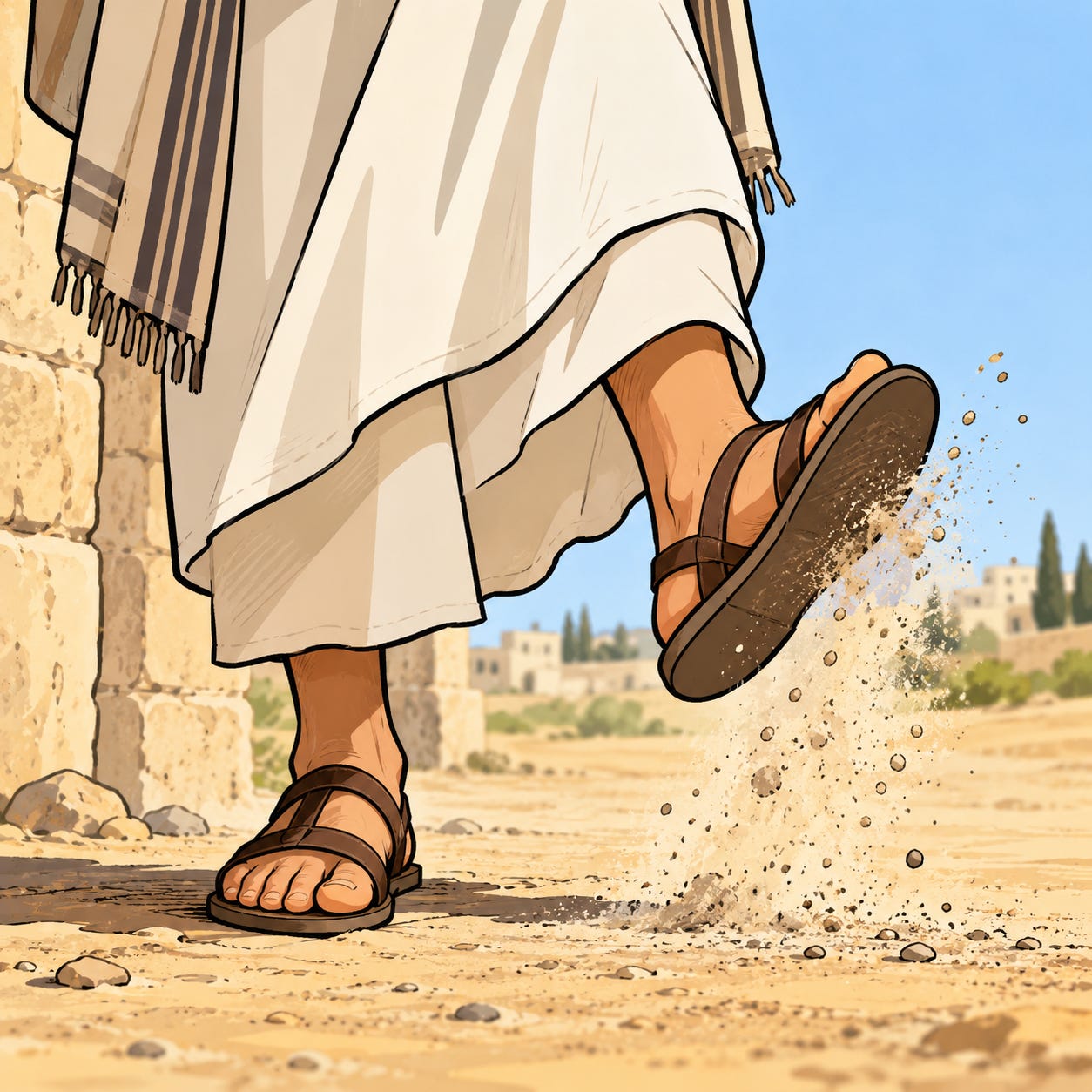
“If anyone will not welcome you or listen to your words, leave that home or town and shake the dust off your feet.” — Matthew 10:14
This is a striking instruction that Jesus gives his disciples when he sends them out. He is sending them to proclaim that the Kingdom of God has come near—to make that Kingdom visible in what they say and do. And he tells them that if they go somewhere and they are not welcomed or listened to, they are to leave that place and shake the dust off their feet.
To the disciples, shaking the dust from their feet would have been a symbolic act: we have brought the message; you have chosen not to receive it; we leave that refusal here and move on.
But I have always found the image wonderfully suggestive in another way too. Because dust travels. You walk through somewhere and, without particularly noticing it, some of that place attaches itself to you. You carry it into the next village. And then into the next one. And I wonder whether that is true of our lives as well. We pass through places, churches, relationships and systems of belief, and sometimes we carry their dust with us long after we have left them.
Some of that dust may have been good. But some of it can be almost ‘radioactive’: invisible, but it sticks. Some of us have spent years carrying messages we absorbed about ourselves—about our sexuality; our gender; our bodies; what God supposedly thought of us; what we had to do before God could really accept us. Shame. Fear. The suspicion that there is something fundamentally wrong with us. The feeling that God tolerates us rather than delights in us. The conviction that other people’s judgement must somehow become our judgement of ourselves.
An important caveat
I should make something clear at the outset. I am not writing this to recommend that LGBTQ+ Christians should necessarily leave churches because they hold conservative or non-affirming views. For some people, leaving may indeed become necessary for their well-being. Others may feel called to remain, to love, to challenge, and to help bring about change. That is a decision each of us has to make for ourselves, prayerfully and honestly before God.
But whether we stay or leave, there may still be dust that needs shaking off.
Part of what Jesus’ striking image offers us is permission to pay attention to what we are carrying. Not every judgement made about us belongs to us. Not every theological verdict pronounced over us has to become part of our identity.
Sometimes shaking the dust off our feet means leaving a place.
But sometimes it means refusing to carry its dust any further.
Human dignity and self-respect
One of the things this is really about is self-respect.
That’s an interesting expression, because when I was growing up, self-respect and respectability could very easily become confused.
A self-respecting person was a respectable person. You behaved properly. You conformed to what society expected of you. You didn’t wash your dirty linen in public. Respectable people stayed married, even when a marriage was desperately unhappy. And gay people certainly didn’t announce themselves. If you were gay, you kept quiet, behaved yourself and fitted in. Self-respect meant, to a considerable extent, becoming the sort of person other people were prepared to respect.
But genuine self-respect is something quite different. I think it begins with the courage to stand truthfully before God. Not arrogantly. Not saying, “Whatever I feel must be right.” Christian authenticity still has to be tested by love, truth, responsibility and our willingness to follow Christ.
But neither does following Christ require us to erase ourselves in order to become acceptable to other people.
And when I look at Jesus, I notice something rather wonderful. Again and again, he restores people’s dignity and self-respect.
Think of the woman in Luke’s Gospel (Luke 13:10-17) who had been bent over for eighteen years. Jesus heals her so that she can stand upright. But he does something more than straighten her back. He calls her “a daughter of Abraham.” He restores her publicly to her place among the people of God.
Everybody else has been looking at a bent-over woman. Jesus sees a daughter of Abraham. There’s an image there for us. Because some of us spent years learning to bend ourselves into shapes that other people could accept. And part of what Christ has been doing among us is teaching us to stand upright again. To restore our dignity. To recover our self-respect. To walk tall.
And that doesn’t mean despising the people who once taught us to bend. It may simply mean recognising that we no longer need their permission to stand.
And there comes a moment when Jesus says: “You don’t have to carry that any further. Shake the dust off your feet.” What belongs there does not have to travel with you.
The world I inherited
I grew up in a very different world from the one in which young LGBTQ+ people are growing up today.
That doesn’t mean everything is easy today. Clearly it isn’t.
And I am very conscious that the experiences of gay men of my generation are not identical to those of lesbians, bisexual people, or particularly trans and non-binary people. I don’t want to pretend that they are. But there is something we share. All of us have had to negotiate messages about who we are which reached us before we were old enough, or free enough, to examine them properly.
For people of my generation, homosexuality was scarcely spoken about except as something shameful. The law had condemned it; medicine had pathologised it; society mocked it; and the Church gave many of us a theological explanation for why it was wrong. So when I became aware of my own sexuality, I didn’t encounter it in a neutral world. None of us does. I encountered it in a world which had already told me what it meant.
And because I was a Christian, the question wasn’t simply: Can I accept myself? It was: Can God accept me? And even more painfully: Can I accept myself and remain faithful to God?
(The answer then, of course, was “No!” How could I accept myself?)
That was the issue which shaped a great deal of my early adult life.
Trying to change
I became involved with Christians who genuinely wanted to help people like me. I want to say that carefully, because it is very easy, looking back from 2026 to 1986 (40 years ago), simply to caricature everybody involved in what came to be called the ‘ex-gay’ movement. That isn’t how I remember it. I met people who were sincere and compassionate, who prayed with us, cared about us and genuinely believed they were offering hope.
I became involved with Martin Hallett and True Freedom Trust. I spent four months with Frank & Anita Worthen and Love in Action in California. And eventually, in 1988, I founded Courage, along the Love in Action model.
We were part of the early charismatic movement and we believed change was possible, because, as Jesus said in the gospels, “with God all things are possible” (Mark 10:27). And in the context he was talking about rich people. So he really was talking about a miracle!
Or, where change didn’t happen, we believed faithful celibacy was the Christian answer.
And into that world came various theories explaining why people apparently became homosexual. Two names that many people of my generation will probably remember are Elizabeth Moberly and Leanne Payne. I think it is important that we remember why their ideas gained such influence.
We were not simply gullible people believing any strange theory that came along. We were desperate for an explanation which would allow us to remain Christian and make sense of our sexuality without concluding that we were reprobate—people who had wilfully rejected God and whom God, in turn, had rejected.
There were remarkably few places to go. And I think there is something very human going on here which I understand much better now than I did then.
Human beings need to make sense of our experience.
When something important happens to us—particularly something confusing or painful—we look for a framework which will explain it. We want to know: Why am I like this? Why has this happened? What does it mean? And what am I supposed to do about it? And sometimes, when we desperately need an explanation, a framework which seems to make sense of everything can be enormously powerful. It can even be a relief.
A bad explanation can sometimes feel safer than having no explanation at all.
So when somebody offered a theory which said, in effect, “Your sexuality has a history; the wounds that produced it can be understood; and through prayer and healing those wounds can be repaired”, that sounded like hope.
Elizabeth Moberly’s developmental theories offered one framework. Leanne Payne’s teaching about inner healing offered another. And people built lives around those ideas. I did. Many others did too. We had found an explanation that seemed to make sense of our lives.
The difficulty was that the theories had never been tested in the way that claims carrying such enormous consequences needed to be tested. And in some of the highly charged Christian environments in which these ideas were taught, critical reflection could easily become suspended in the name of being “open to the Spirit.”
Then, when change didn’t happen, another problem developed. The theory itself was rarely questioned. Instead, the person was. For instance, I started examining myself: Was there still some unconfessed sin in my life? Hadn’t I surrendered enough? Was there some hidden wound that needed healing? Obviously I couldn’t have prayed properly or had sufficient faith. This was all extremely corrosive to my own sense of well-being yet seemed so “spiritual”—as we were called to examine ourselves every Sunday in church.
The fact remains that the burden of explaining failure fell upon the person seeking healing. And that can become a crushingly heavy burden to carry.
When sincere faith is not enough
I also married. My wife ‘knew’ that I was gay when we married (although she said years later that she had no idea what that meant at the time. She just saw me as a man faithfully seeking to follow God even if that meant self-sacrifice).
This was based on friendship, loyalty, kindness and companionship. There was real love between us. Our marriage lasted more than twenty years, and I remain enormously grateful for the love, friendship and life we shared. So I don’t want to rewrite that history and say that everything about our marriage was false. It wasn’t.
Companionship and friendship are not the same thing as marriage.
We had the qualities that matter enormously in any marriage. But there was something else I hadn’t adequately understood. Our bodies matter too. My wife often used to say that she felt like a “non-person”. I had no idea what she meant then. But later we both discovered that there is something profoundly important about being desired by the person to whom we have given ourselves, and genuinely desiring them in return.
The same truth applies both to same-sex relationships and heterosexual relationships. Two people can be wonderful friends without necessarily being able to sustain a healthy marriage together.
There is, of course, a huge difference between desire changing within a marriage through age, illness, disability or the ordinary changes of a long life … and entering a marriage in which fundamental orientation means that mutual desire was never really possible in the first place.
Eventually my wife and I had to acknowledge something that sincerity, prayer and determination could not change:
Sincerity does not make something true.
You can believe something with all your heart. You can pray and sacrifice for it. You can even build your life around it—and still discover that you were mistaken. That can be devastating. But it can also be the beginning of freedom.
When your life becomes evidence
There was another difficulty which I understand better now than I did at the time.
When you have publicly committed yourself to a particular understanding of your life, eventually it can become more than something you believe. You can become evidence that the belief is true.
I was reminded of this recently by something Randy Scobey, who was once deeply involved in the ex-gay organisation Exodus International, has written about his own experience. People within movements like ours could become, in effect, “living evidence” that the message worked. And that creates an extraordinary pressure.
If people have listened to your testimony, supported your ministry, prayed for you, given money, recommended you to others and perhaps made important decisions about their own lives because of what you have told them, admitting that your experience no longer fits the story can feel like betraying everybody. It may even feel like betraying God.
And there is another problem. A closed explanatory system can become remarkably good at protecting itself. If somebody apparently changes, that confirms the theory. If they don’t change, the explanation can easily become that they haven’t prayed enough, surrendered enough, dealt with some hidden wound, or exercised sufficient faith.
Either way, the framework survives.
And so telling the truth about what is actually happening in our lives can become frightening. We are no longer merely questioning an idea. We may be threatening a whole structure of meaning which other people—and perhaps we ourselves—have built around us.
Sometimes, then, another kind of dust has to be shaken off: the identity we have learned to perform because other people need us to be that person.
Freedom may begin when we allow the truth of our actual lives to speak for itself.
Our lives do not have to remain evidence for a story that no longer tells the truth about us.
When Courage changed
During the late 1990s, I reached a point where I could no longer reconcile what we were teaching with what I was actually seeing in people’s lives. The promised change simply wasn’t happening. People were sincere; they were praying and trying wholeheartedly to be faithful to God; yet their fundamental sexual orientation remained.
And in addition, there was the rather telling fact that people who were experiencing loving same-sex relationships were flourishing. But we could not bring ourselves to believe that such relationships might themselves come within God’s remit of “All things are possible for God”! We can be so selective about how we apply our favourite texts.
At some point you have to ask whether the problem really lies with all the people for whom the theory isn’t working—or whether there might just be something wrong with the theory.
For Courage, that became a turning point.
In 2000, we announced our change of direction and became affirming of gay relationships.
That change came at a huge cost: people who had supported us felt betrayed; some Christians who had regarded Courage as a faithful ministry now regarded us as having abandoned biblical truth, apostate even. There was rejection. There was loss. But sometimes faithfulness to Christ requires us to leave somewhere we had once believed we were called to remain.
And that brings me back to those words of Jesus: “Shake the dust off your feet.”
There are times when remaining is no longer faithfulness. There are moments of revelation when we realise at last that endlessly trying to persuade people who have decided not to hear us is not faithfulness either.
Sometimes Jesus says: “Go!”
Leaving Egypt is not the same as becoming free
But I discovered something else: You can leave a system without the system leaving you. Israel came out of Egypt remarkably quickly. Getting Egypt out of Israel took rather longer. And I think something similar happens to many LGBTQ+ Christians. We may leave the church which condemned us; reject the theology which told us there was something fundamentally wrong with us. We may enter a loving relationship. We may even marry…
…and still carry the dust. We can still hear the old voices. “Are you sure God approves? Is this relationship settling for second best? And so on . . .”
That is internalised shame.
And it can survive long after the theology which produced it has been intellectually rejected. The head has moved on. The heart—and sometimes the body—has not. Our nervous systems can learn danger long before we have words for what is happening, and years later an old trigger can still set off the alarm even when our conscious mind knows we are safe.
But shame has another dimension too. It is not only about what I think of myself. It is also about what I fear other people will think of me.
For LGBTQ+ people of my generation, that could be extraordinarily powerful. To tell somebody, “I am gay,” was not simply to give them one piece of information about yourself. You knew that in their mind it might immediately acquire all sorts of other meanings: immoral; reprobate; sexually suspect; a danger to marriages or children; somebody whose Christian faith and motives could no longer be trusted.
And once you had told somebody, you had surrendered control over your own reputation. In my experience, confidentiality around homosexuality was very rarely what it should have been. People who had disclosed something deeply personal to a pastor, counsellor or trusted Christian friend could discover that others had been told without their permission. Gossip sometimes even acquired a respectable Christian disguise: “I thought I ought to tell you so that you can pray…”
Coming out could therefore feel, strangely, like participating in your own public disgrace. You were telling the truth about yourself while knowing that other people might use that truth to construct a version of you that you scarcely recognised.
For those of us brought up to value respectability, that was enormously costly.
And yet here is the paradox I have come to see.
Sometimes the apparent loss of respectability is precisely where self-respect begins.
There comes a point when we have to relinquish the impossible task of keeping control over everybody else’s opinion of us. Jesus himself was misunderstood, misrepresented and accused of things which were not true. Yet he did not spend his life running after everybody who had formed the wrong opinion of him, desperately trying to repair his reputation.
That does not mean adopting the brittle defence, “I don’t care what anybody thinks of me.” Of course we care. Reputation matters. Truth matters. Other people’s opinions can hurt us profoundly.
But freedom sounds more like this: I care about truth, but I no longer require everybody else’s approval in order to know who I am.
And that, too, is part of shaking the dust from our feet.
I cannot prevent you from judging me.
But I no longer have to turn your judgement into my shame.
Shaking the dust from our feet isn’t simply changing our theological opinion. It is learning not to carry yesterday’s condemnation with us into tomorrow’s life.
Jesus and the dust
And notice who says this. Jesus—the one who tells us to love our enemies, who forgives, who goes looking for the lost. And yet this same Jesus says there are times when we should leave. Because some of us were taught that Christian love meant remaining indefinitely in situations which diminished us. And so we keep explaining, keep trying to prove ourselves, keep submitting; hoping that eventually the people who have rejected us will understand.
But Jesus doesn’t say any of that.
There are times when he says: “Shake the dust off your feet and walk on.”
Not in hatred or revenge. And not because the people you leave behind cease to matter.
But because their refusal to receive us does not have to become our permanent identity.
There is a difference between forgiveness and remaining captive; a difference between love and allowing somebody else continually to define you. And there is a difference between humility and shame.
And not everything should be left behind
There is another qualification I want to make. I don’t want to shake everything from my past away. That would be another kind of dishonesty. There are some things within conservative evangelical Christianity for which I remain profoundly grateful. I learned to love Jesus, to take Scripture seriously and to pray. I learned that faith was something around which you could build a life. And I met some extraordinarily good people.
And within Courage before 2000, there was still tremendous love, friendship, prayer, sacrifice and genuine pastoral care. Most especially those early Courage days ended people’s isolation. Many of us who met in the mid 1980s are still close friends 40 years later! We took this journey together.
So shaking the dust off our feet doesn’t mean declaring that everything about the place we have left was worthless.
Maturity means being able to say: This was good. This was harmful.
This I will carry with gratitude. This I will leave behind.
That is discernment! Very different from nostalgia or repudiation.
Because the purpose of shaking the dust off our feet really isn’t to spend the rest of our lives staring at the dust! It is to walk. It is to have confidence in our journey with God.
We have no idea who is watching
There is another reason why it matters that we learn to live confidently as the people God has called us to be. Because we have absolutely no idea who may be watching.
When Courage was meeting at a church in central London, a new evangelical vicar arrived. It was early 2000, I think. And immediately I wondered, “Would he agree to us continuing to meet there?” We’d been turned out of churches before!
I remember the first email I received from the new vicar which said, more or less:
“Half the PCC think I should throw you out. The other half will leave if I do.
I don’t know what I think about this, but on the basis that the Bible calls us to offer hospitality, you are welcome to stay.” I have always remembered that. This vicar wasn’t persuaded about homosexuality. He certainly wasn’t ready to declare himself an advocate of same-sex relationships.
But he offered hospitality. And hospitality gave him the opportunity to see. He saw our fellowship, our worship; he saw people praying together and supporting one another.
He saw the life that was actually being produced among us. And over the years, what he saw changed him.
When Courage celebrated its twentieth anniversary in the autumn of 2008, this same vicar came and spoke at our celebration. What he had witnessed among us had helped convince him that God really was at work in the lives of LGBTQ+ Christians.
And then, just this past week, he contacted me again. He is now writing a book in full support of same-sex marriage—and he has asked me to help him with it. I find that rather wonderful.
I never set out to convince him. We were simply trying to follow Christ ourselves. For years LGBTQ+ Christians have had to explain and defend ourselves, and sometimes those arguments are necessary. But this faithful man reminds me that there is another kind of testimony.
Jesus said, “By their fruit you will recognise them.”
Sometimes people simply need the opportunity to see the fruit. And most of the time we will have absolutely no idea who is watching.
That is part of our vocation now.
Not endlessly to relive the battles of yesterday, or allow the battles still being fought today to set the tone for our lives. Not to carry resentment as though bitterness were proof that injustice mattered. But to keep what was good, grieve what was lost, learn what the journey has taught us—and then walk. Not arrogantly, or pretending we have all the answers. But knowing that our lives belong to God, that we are capable of loving and being loved, and that Christ has not finished with us.
Different dust, the same invitation
And although I have inevitably been talking mainly about the experience of LGBTQ+ Christians, I don’t think this message belongs only to us.
I think, for instance, of some truly remarkable women I have known whose calling and ministry have enriched the lives of countless people—and yet who still encounter Christians who believe, as a matter of principle, that they should never have been ordained.
There is something deeply painful about that. A woman may have faithfully preached the gospel, cared for the dying, baptised children, comforted the bereaved, celebrated the Eucharist, helped people discover faith and served a Christian community for years—and still encounter someone who effectively says, “I do not recognise your ministry.”
Of course people are entitled to hold theological convictions. But there comes a point when we need to ask whether our interpretation of a principle has become so important to us that we can no longer see the person standing in front of us—or recognise the fruit of what God may actually be doing through them.
That is different dust from the kind LGBTQ+ Christians have carried. But the danger is remarkably similar: allowing somebody else’s refusal to recognise us to become the measure by which we recognise ourselves.
This is where Jesus’ words become an invitation to any of us who have spent too long standing outside somebody else’s door, waiting for permission to become the person God has called us to be.
Walk Tall
So let us walk tall—because grace has never required you to crawl.
Walk tall—because you are loved.
Walk tall—because there is still a road ahead.
Somewhere
There is a song from the musical show West Side Story that has spoken to generations of people who have longed for a place where they could simply belong.
“Somewhere,” with music by Leonard Bernstein and lyrics by Stephen Sondheim, is a song born out of a world of division. At its heart is a longing for another kind of world—a place beyond hostility and exclusion, where love no longer has to struggle simply for permission to exist.
Perhaps that is one reason it has resonated so deeply with so many LGBTQ+ people. For much of our history, “somewhere” was exactly what we were looking for: somewhere we would not have to hide; somewhere faith and love would no longer be enemies; somewhere we could stand upright without apology and discover that there really was a place for us.
After all, the journey is not only about finding that place somewhere else. It is also about becoming free enough to inhabit the life we have been given here and now.
To stop waiting outside somebody else’s door for permission to belong.
To stop allowing somebody else’s judgement to become our judgement of ourselves.
To recognise the dust we have accumulated along the way—and to decide that it does not have to travel with us any further.
There is a road ahead.
Shake the dust off your feet.
And walk.
Jeremy Marks, 21st September 2026
I loved this. My husband and I were Courage supporters in the early days and I remember so well when you and James changed tack - and how much I admired your courage (sorry - accidental pun!). I still do. I became convinced by the fruit shown by gay Christians and have continued to follow that theologically over the years since. May God continue to bless your work and your writing.
very well written. Of course!