
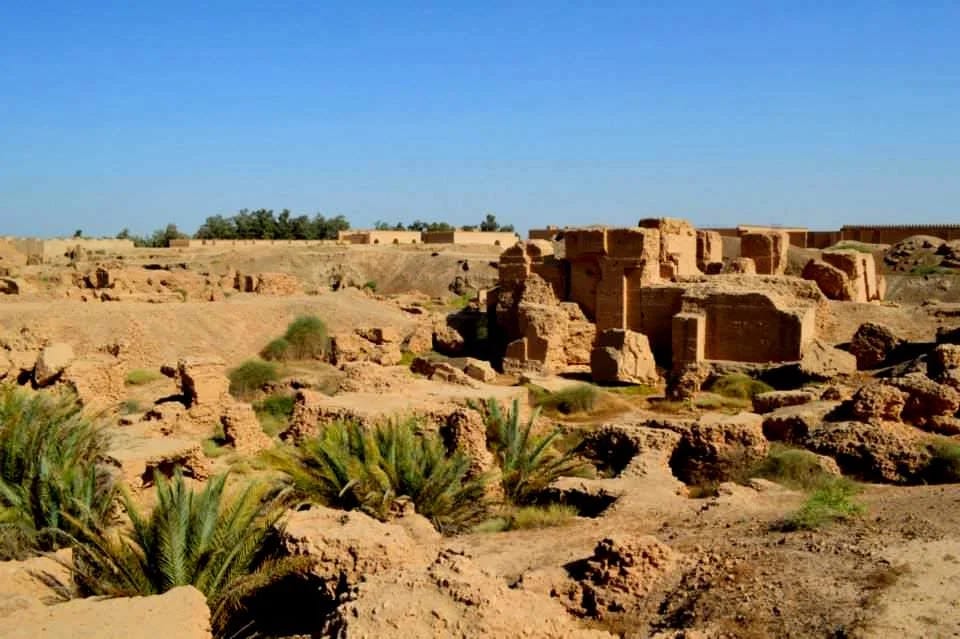
Photo: Ruins of the North Palace of Nebuchadnezzar II by Osama Shukir Muhammed Amin, via World History Encyclopedia, licensed under Creative Commons Attribution–NonCommercial–ShareAlike 4.0.
Babylon's ruins still stand, but its empire has long since vanished. Jeremiah's words outlived the civilisation that once held his people captive.
“‘Build houses and settle down; plant gardens and eat what they produce... Seek the peace and prosperity of the city to which I have carried you into exile... Pray to the Lord for it, because if it prospers, you too will prosper.’ (Jeremiah 29:5–7)
‘For I know the plans I have for you,’ declares the Lord, ‘plans to prosper you and not to harm you, plans to give you hope and a future.’ (Jeremiah 29:11)
Hope in the Middle of Babylon
One of the best-loved verses in the whole Bible comes from Jeremiah 29:
“For I know the plans I have for you...”
Many of us have heard those words at difficult moments in our lives. They have encouraged Christians for generations. Yet I suspect most of us—including me for many years—have seldom paused to ask what was actually happening when God first spoke them.
These words were not spoken to people whose lives were about to become easier. They were addressed to a nation living in exile. Jerusalem lay in ruins. Many had lost family members, homes and everything that had once seemed secure. False prophets were promising that the nightmare would soon be over. Jeremiah had the difficult task of telling them otherwise. They were to settle down in Babylon because they would be there for many years.
And that was precisely where God promised them a hope and a future.
Many people today have a nagging feeling that the world they grew up in is slipping away.
Sometimes it is difficult to put into words exactly what has changed. Perhaps it is the increasingly angry tone of public life. Perhaps it is the way truth itself so often seems to be treated as negotiable. Perhaps it is the speed with which technology, culture and society continue to change. Many people feel unsettled by it all. Some feel anxious about the future. Others quietly wonder whether the values they have tried to live by still have a place in the world that is emerging around us.
It is not only older people who feel this. Every generation has its own uncertainties. Yet many of us who have lived through decades of extraordinary social change find ourselves asking, “How are we meant to live faithfully now?”
That is a much older question than we sometimes imagine.
When Jeremiah wrote to the Jewish exiles in Babylon, they too were living in a world they had never expected. Everything familiar had been turned upside down. They had lost their homes, their security and much of what had given shape to their lives. Some longed desperately to return to the past. Others could scarcely imagine a future worth hoping for.
Their experience is far from ancient history. Even today, millions of people across our world are living through the trauma of war, displacement, devastating loss and profound uncertainty. Jeremiah’s letter was not addressed to people still caught in the immediate horrors of war, but to exiles who were slowly coming to terms with the painful reality that they might be living in Babylon for many years to come. It is to them that God speaks one of the great surprises of Scripture.
Planting Gardens
Instead of telling them to withdraw from Babylon, or to spend their days dreaming of escape, he tells them to settle down. Build houses. Plant gardens. Raise families. Seek the welfare of the city. Pray for it. Learn how to become a blessing in the very place where they would least have chosen to live.
I find that astonishing.
God does not promise to remove them immediately from difficult circumstances. Instead, he invites them to discover that he is already present within them.
The older I become, the more I think this may be one of the most important lessons for Christians living today.
Those of us who have lived in Western Europe since the end of the Second World War have experienced an extraordinary period in history. Standards of living have risen beyond anything previous generations could have imagined. Medical advances have transformed countless lives. Travel has become commonplace. Opportunities once reserved for the wealthy have become available to millions. These are blessings for which we should be deeply grateful.
Yet perhaps they have also tempted us into assuming that history naturally moves from strength to strength; that peace, prosperity and stability are somehow normal. As many of those assumptions are now being shaken, it is understandable that people feel anxious about what lies ahead.
Jeremiah gently reminds us that our deepest hope was never meant to rest on favourable circumstances. God’s people have often discovered him most profoundly, not when life was easiest, but when everything familiar seemed to be slipping away.
We cannot choose the times into which we are born. Every generation faces its own challenges. Some generations face war. Others economic collapse. Others persecution. Ours faces a different constellation of concerns: climate change and environmental degradation, deep political division, growing loneliness, rapid technological change, and an increasingly fragmented public conversation. None of us knows quite what the coming decades will bring.
But perhaps that is not the most important question. The more important question is what kind of people we are becoming while history unfolds around us.
Jeremiah’s answer is beautifully practical. Plant gardens.
That is about much more than horticulture. It is an invitation to become people who cultivate life wherever they find themselves.
The image has stayed with me because gardens are places of patient hope. Nobody plants a seed expecting instant results. A gardener works because he believes that hidden life is already present, even when nothing much can yet be seen. Every act of care becomes an expression of confidence that growth is possible.
Christian hope is rather like that.
Hope is not pretending that everything is fine. Jeremiah certainly wasn’t naïve. Traditionally he is associated with the Book of Lamentations, one of the Bible’s great cries of grief over the destruction of Jerusalem. He knew how to lament. He knew what it meant to watch a society unravel. Yet he also knew that lament and hope belong together.
That is something we desperately need to recover.
Christians are not called to deny the darkness. Nor are we called to surrender to it. We are called to keep planting gardens.
As I have reflected on this, I have found myself thinking about Etty Hillesum, the young Jewish woman whose remarkable diaries were written during the Nazi occupation of the Netherlands. Living under circumstances infinitely darker than most of us can imagine, she wrote that perhaps our calling was “to safeguard that little piece of You, God, in ourselves. And perhaps in others as well.”
What an extraordinary thing to write. She understood that love is not escapism. It is participation in the deepest reality of the universe.
That, surely, is what Jeremiah was asking of the exiles. Babylon did not have to determine the kind of people they became. They could still choose truthfulness over deceit, generosity over fear, kindness over contempt. They could still cultivate the life of God in the midst of a society that often reflected very different values.
There is another reason why Jeremiah’s words continue to speak so powerfully today.
Babylon looked invincible.
They Outlived Babylon
Its armies had conquered nations. Its rulers believed their empire would last forever. From a human point of view, the exiles must have wondered whether Babylon represented the future and whether everything they had loved belonged to the past.
History tells a different story.
Babylon’s ruins still stand, but its empire has long since vanished. The kings who once imagined their power would endure forever are remembered mainly by historians. Yet the faith of those Jewish exiles still shapes the lives of millions of people across the world.
The same pattern has repeated itself throughout history. The Roman Empire looked permanent. It wasn’t. Countless political systems, ideologies and empires have imagined themselves to be the final chapter of history. None of them has endured.
Truth and love, however, have a remarkable way of outliving them all.
That is why the witness of people like Betsie and Corrie ten Boom continues to speak with such power. In Ravensbrück concentration camp, where cruelty and hatred seemed to govern everything, Betsie repeatedly urged her sister, “No hate, Corrie.” Those words were not spoken because evil was unreal, but because she understood that hatred was the one victory she could not afford to grant her oppressors. If hatred captured her own heart, evil would have reproduced itself within her. The greatest victory evil can achieve is not to wound us, but to make us resemble itself.
After the war, Corrie herself faced the agonising test of that conviction when she found herself standing before one of the former guards who had helped to brutalise her sister. Every instinct cried out against forgiving him. Yet she knew that, if she was to continue following Christ, she could not allow the concentration camp to have the final word in her own soul.
Love is not escapism. It is participation in the deepest reality of the universe.
A Renewed Imagination
Perhaps that is what Jeremiah wanted his fellow exiles to discover. Their calling was not merely to survive Babylon. It was to live from a reality that Babylon could neither understand nor destroy.
And perhaps that is our calling too.
We are not simply waiting for better times to come. We are learning to live now by the values of the kingdom that will still be standing when every Babylon has passed away.
The exiles did not overthrow Babylon. They outlived Babylon.
This is why I think Jeremiah speaks with such fresh relevance today. We are not being asked to recover a vanished past, however much we may value many of the things it gave us. Nor are we being asked to surrender to despair about the future. We are being invited to recover something much older and much deeper: the imagination of God’s kingdom. That is where our hope has always been found.
The secret, I think, lies in something Paul would later write to the Christians in Rome:
“Do not be conformed to this world, but be transformed by the renewing of your minds.” (Romans 12:2)
We often imagine that if only our circumstances could be changed, we would find peace again. Paul quietly turns that assumption on its head. Transformation, he says, begins not with changing our circumstances but with the renewing of our minds. Only then are we able to discern God’s “good, pleasing and perfect will.”
That is precisely what Jeremiah was trying to do for the exiles. Babylon was not only a geographical location; it was a way of seeing the world. God’s people were to live there without allowing Babylon’s imagination to become their own. They would build houses and plant gardens, not because Babylon had become good, but because they believed that God’s future was already quietly taking root within the present.
Jesus lived in exactly the same spirit. He never allowed the violence, fear or hostility around him to dictate the atmosphere within him. Wherever he went, he carried the kingdom of God with him. He met suspicion with grace, shame with welcome, suffering with compassion and fear with peace. He planted gardens in Babylon.
That is our calling too.
Not to win the culture wars, nor to spend our lives lamenting everything that has changed, but to become people whose lives quietly make the world around them more habitable. Every truthful conversation, every act of forgiveness, every lonely neighbour welcomed, every child encouraged, every refusal to join in bitterness becomes another seed planted in God’s future.
We do not know what lies ahead for our society. Neither did Jeremiah’s first readers. Neither did the first Christians. Neither did Etty Hillesum, Betsie or Corrie ten Boom. Yet each discovered that God was already waiting for them in the future they could not foresee. But all of them discovered that God’s kingdom does not wait for ideal circumstances before it begins to grow.
That is why Christians can look towards the future with something more than optimism; why Christians can face uncertain times with something that almost resembles adventure. Not because suffering is exciting, nor because we underestimate the darkness, but because every generation is given its own opportunity to bear witness to the life of God’s kingdom.
We do not choose the times into which we are born. We do choose the spirit in which we will live through them.
Perhaps that is why this need not simply be a time of anxiety for Christians. It may also become a time of rediscovery. A time to remember that our hope has never depended on material prosperity, political stability or cultural influence, valuable though all these things may be. It has always rested in the One who is the Light of the world, and whose life can never be extinguished.
We may sometimes wonder whether anything we do can really matter in a world facing such immense challenges. The problems seem so vast, and our own lives so small. Yet the Kingdom of God has never advanced because a few people changed everything. It has always grown through countless ordinary acts of faithfulness, each one rooted in trust that God can accomplish far more than we can see.
God asks us to be faithful, not because we can foresee the outcome, but because no act of love is ever wasted in his Kingdom.
Every generation is given its own opportunity to bear witness to that light.
Perhaps this is ours.
And perhaps that is what it means to plant gardens in Babylon.
Jeremy Marks, 24th July 2026
Encouraging! Thanks, Jeremy.
Really struck a chord. For LGBTQ Christians in exile maybe an interpretation could be not to allow the evil of abusive and/or homophobic religious leaders to have the last word. Perhaps the church-as-empire is part of whats collapsing around us. But God still waits in the future