
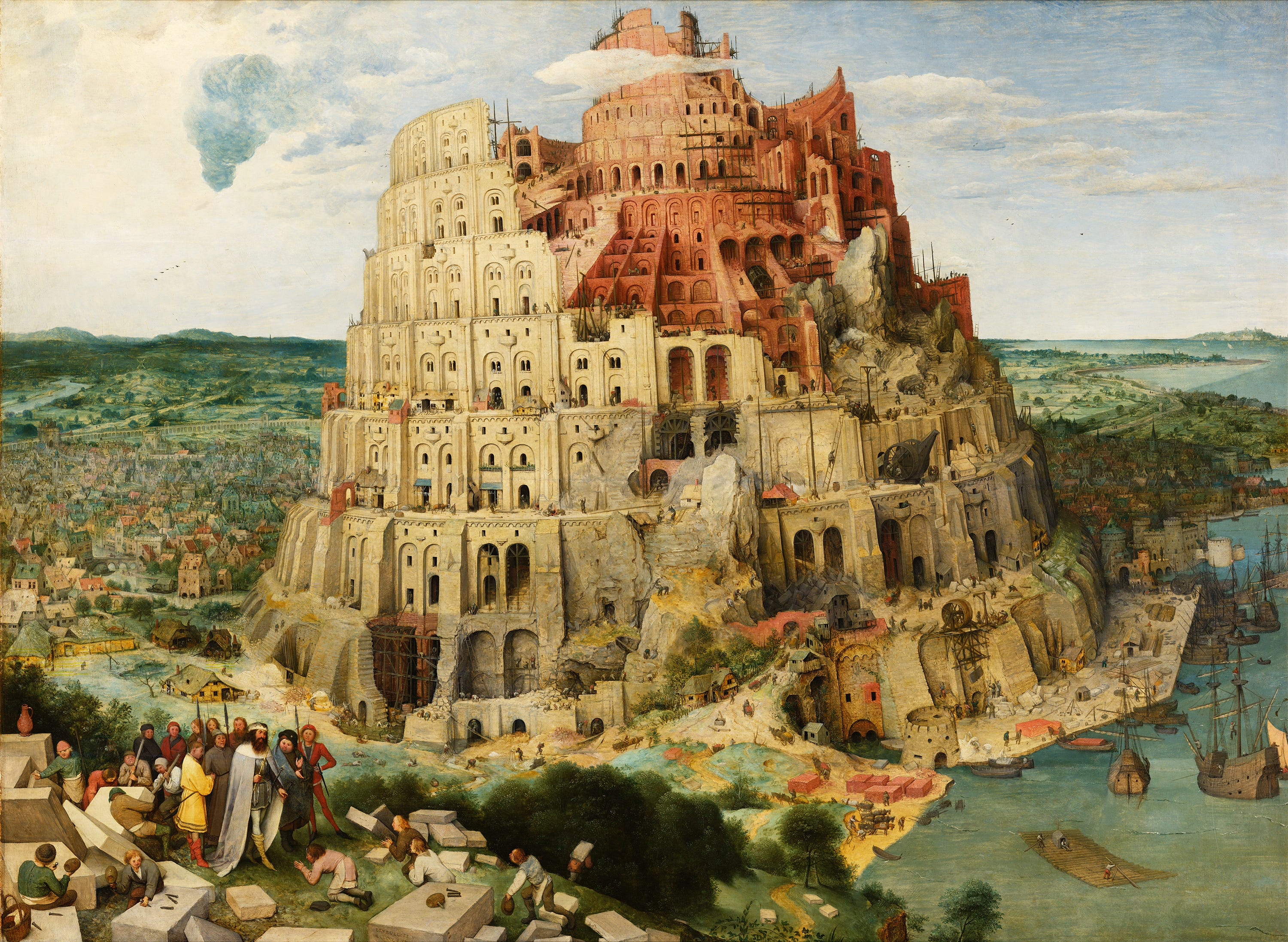
Pieter Bruegel the Elder, The Tower of Babel (1563), oil on panel. Kunsthistorisches Museum, Vienna. Public domain.

Burj Khalifa, Dubai — currently the tallest building in the world.
Photograph widely available online; photographer unknown
The story of the Tower of Babel (Genesis 11:1–9) is one of the most familiar—and most misunderstood—narratives in the Old Testament. For many people, it immediately summons a vivid image: a vast spiralling tower reaching defiantly toward the heavens, fixed in the imagination by medieval and Renaissance paintings, most famously those by Pieter Bruegel the Elder (1563). These images are so powerful that they quietly persuade us we already know what the story is about.
Usually, the story of Babel—and of God confusing the language of the people—is remembered as a warning against human arrogance: a tale about technological over-reach or the hubris of “trying to reach God.” God’s response is dramatic, but it is also profoundly non-violent as divine interventions go.
When we slow down and study the text, something more subtle and more unsettling emerges. In fact the builders of Babel are not primarily driven by pride, but by a desire for uniformity—an attempt to reduce vulnerability by eliminating difference, and with it the unpredictability that makes trust necessary. Their stated concern is not transcendence, but security:
“Come, let us build ourselves a city and a tower… lest we be scattered” (Genesis 11:4).
The tower is a defensive project—an attempt to manage vulnerability, uncertainty, and loss of control, rather than a monument to ambition.
Seen this way, Babel is not a story about height at all. That is worth noting, in a world that has since built structures the ancient imagination could never have conceived. The tallest building on earth today, the Burj Khalifa in Dubai, rises more than eight hundred metres into the sky. If the builders of Babel feared that height itself might provoke divine judgement, they need not have worried.
The problem was never about how high the tower rose. It was why it was built.
That is why the story remains so unsettlingly relevant.
What follows in the biblical narrative is not the destruction of the tower, but the disruption of its purpose. The confusion of language is not a petty punishment; it is a release—an unravelling of a project that had begun to value cohesion over calling, uniformity over trust, permanence over relationship.
Crucially, Babel is also a story about self-sufficiency. The tower is an assertion that human ingenuity can secure what vulnerability once required God for. It is a collective demonstration of capability—an attempt to render dependence unnecessary, and trust obsolete.
In this light, Babel is not the opposite of faith. It is faith distorted by anxiety: belief reshaped into certainty, trust replaced by control, and dependence quietly engineered out of the picture.
And this is precisely where the story begins to illuminate our modern dilemma as Christians.
Institutions: born from good intentions, sustained by anxiety
Institutions—including religious ones—rarely begin badly. They arise to preserve wisdom, pass on memory, coordinate care, and sustain shared life. They grow out of genuine need. The problem comes later, when the institution itself becomes the thing that must be protected at all costs.
At that point, a subtle but decisive shift takes place.
What once existed to serve people begins to require their silence.
What once held truth becomes threatened by it.
What once fostered faith begins to manage fear.
This is not because institutions are evil. It is because they are human.
When Institutions Forget Their Calling
I did not arrive at these conclusions as an outsider to institutions, but through years of trying—earnestly and at cost—to build and sustain them. My own experience made this painfully clear. I have helped to build both a business and a charitable trust, and in each case I learnt very quickly that institutional legitimacy offers only brief reassurance. Before long, it becomes a constraint.
With the charitable trust especially, legal requirements transferred vision and risk from those who carried the calling to those tasked with preventing failure. An independent board of unpaid trustees—honourable, conscientious, and deeply risk-averse—gradually took responsibility for decisions they had never imagined, for a vision they had not received, and for consequences they feared intensely.
The result was not corruption, but paralysis.
Over time, the institution’s primary task became ensuring that nothing went wrong. The ministry’s original purpose was quietly displaced by the logic of protection. Within twelve years, the work was no longer possible within that structure at all.
Experiences like this strip institutions of their mystique. One begins to see that every organisation—whether a charity, a church, a healthcare system, or even a nation-state—is the result of human decisions made at particular moments under particular pressures. Constitutions, governance models, safeguarding procedures, and hierarchies are not divine givens. They are inventions.
And what has been invented can, at least in principle, be changed.
This does not mean institutions are dispensable. Without organisation, many forms of care, coordination, and shared provision would be impossible. The problem is not institution-building as such, but what comes to motivate institutions once they exist.
When service is the governing purpose, it is possible for structures to remain flexible, revisable, and accountable to the people they serve. When anxiety creeps in—fear of collapse, scandal, loss of control, or reputational damage—institutions begin to defend themselves, even at the cost of the very goods they were created to protect.
And like the tower at Babel, they are often built—and fiercely defended—out of an unspoken dread of collapse, loss, or dispersal.
Between Babel and Pentecost
The Christian story, however, does not end at Babel.
Its counterpoint is Pentecost—a moment not of enforced unity, but of diversity held together by the Spirit. Where Babel sought safety through sameness, Pentecost reveals communion without control. Where Babel feared scattering, Pentecost blesses difference. Where Babel clung to human construction, Pentecost trusts divine presence.
This places Christians in a permanent tension—a space between Babel and Pentecost—where institutions may be necessary, but are never ultimate.
And it is within this tension that the modern question presses so insistently:
How are we to serve God faithfully—from within institutions, or from outside them—when truth, conscience, and compassion come under pressure?
It matters to ask whether fear-driven institutionalisation is inevitable—or whether human communities could have imagined life differently.
A Different Imagination of Shared Life
A striking contrast can be found in the traditional life of some Indigenous North American peoples, such as the Cherokee. Their society did not centre itself around institutions in the way Western cultures instinctively do. Land was not owned in the European sense, wealth was not accumulated, and there was little admiration for the drive to acquire more and more. What was most honoured was integrity—especially in elders—rather than productivity, status, or material success. European settler colonists repeatedly criticised the Cherokee for lacking ambition, never pausing to ask whether this judgement revealed something about their own spiritual poverty.
This is not to romanticise tribal life, which had its own hardships and moral complexities, but to notice that human communities have existed—and flourished—without the constant need to secure themselves through growth, permanence, or control. In this light, Babel begins to look less like a universal human impulse—and more like a culturally specific response to fear. It is not the only way human communities have learned to live together
Pentecost: When Fear Loses Its Organising Power
If Babel names what happens when fear becomes the organising principle of human life, Pentecost names what becomes possible when fear is displaced by trust.
The outpouring of the Spirit in Acts 2 is often celebrated for its drama—wind, fire, and ecstatic speech—but its deeper significance lies elsewhere. Pentecost does not create a single language, a single culture, or a unified human project. It does not reverse diversity. It blesses it.
Where Babel sought security through uniformity, Pentecost creates communion without sameness. People hear the same good news, but each in their own language. Difference is not overcome; it is honoured. The Spirit does not erase culture, memory, or particularity. Instead, God is encountered within them.
This is a decisive theological shift.
At Babel, unity had to be managed.
At Pentecost, unity emerges as gift.
At Babel, cohesion was imposed rather than received.
At Pentecost, community arises from within.
And crucially, Pentecost introduces a way of being together that no institution can fully control.
A Church Without Fear—and Without Ownership
The immediate consequence of Pentecost is not a creed or a hierarchy, but a transformed pattern of life. Acts tells us that the early believers “held all things in common,” shared resources freely, and ensured that “there was not a needy person among them.”
This was not idealism.
It was not strategy.
It was the fruit of trust.
They were not attempting to build a perfect society or to preserve something fragile. They were responding to abundance—not an abundance of resources, but an abundance of life. Their hearts were caught up in joy, their imaginations opened by hope, and the Spirit’s presence displaced the old anxieties about survival, status, and scarcity.
What is striking is that this way of life did not arise from institutional design, strategic planning, or the desire to build something lasting. It arose from service. The community that forms after Pentecost is not oriented toward expansion, reputation, or permanence, but toward attentiveness—toward who has need, and how that need might be met.
The early church did not share from excess. They shared under pressure. They lived with external insecurity, social hostility, and material uncertainty—and yet Acts tells us that “there was not a needy person among them.” Their confidence did not lie in having much, but in trusting that enough would be given as it was needed.
This is perhaps why the life of the early church unsettles us so deeply. It raises the uncomfortable possibility that much of what we treat as necessity is, in fact, anxiety. And it asks whether, in the event of real loss or societal breakdown, we might yet discover—as they did—that we already have enough.
It demonstrates that a community can exist—at least for a time—without fear organising its economic, social, or spiritual life.
No tower.
No institution to defend.
No borders to police.
Only relationship, shared responsibility, and attentiveness to need.
Why Pentecost Is So Difficult to Sustain
And yet this way of living proved extraordinarily hard to reproduce.
From the earliest pages of the New Testament, we see tensions emerge: disputes over food distribution, accusations of unfairness, debates about authority, leadership, and belonging. Within a few generations, the church begins to institutionalise—not only out of ambition, but out of necessity.
This is where honesty is required.
The problem is not that Pentecost communities failed.
The problem is that fear returned.
Fear of chaos.
Fear of false teaching.
Fear of fragmentation.
Fear that the fragile miracle might dissolve.
And so structures were built.
Rules were agreed.
Boundaries drawn.
Offices established.
None of this was inherently wrong. But slowly—almost imperceptibly—the organising principle shifted. Where once life had been trusted to the Spirit, confidence moved elsewhere. “We do the organising,” we began to assume.
Trust gave way to management.
Discernment gave way to control.
Relationship gave way to regulation.
What began as Spirit-breathed life gradually took on the architecture of Babel once more.
When Institutions Re-Enter as Protection Against Fear
This pattern repeats itself relentlessly through Christian history.
You see it in monastic movements that begin with radical simplicity and end in complex rule-keeping.
You see it in revival movements that start with fire and end with constitutions.
You see it in the charismatic movement of the 1970s and 80s—a moment of genuine Pentecostal imagination—which, under pressure, re-consolidated into hierarchies often more rigid than those it originally resisted.
This is not primarily a failure of imagination.
It is a failure of nerve.
When fear returns, institutions promise safety.
They offer clarity, stability, and continuity.
They reassure us that something solid will remain.
But the cost is always the same.
Truth becomes conditional.
Prophetic voices become inconvenient.
And those who cannot conform quietly drift out—or are pushed.
Not because they lack faith.
But because the institution can no longer tolerate the risk they represent.
This is why encounters with alternative ways of living are so often dismissed rather than received. The Cherokee were not defeated by argument, but made to seem irrelevant by the dismissive assumptions. Their way of life was judged before it was heard. What was at stake was not evidence, but superiority—the conviction that there was nothing left to learn.
I have seen this same dynamic repeatedly in my own life. Again and again, I have encountered the overwhelming assumption that for anything to be trustworthy, viable, or allowed to flourish, it must first acquire official status. Authorisation becomes a substitute for discernment. Permission replaces trust. Creativity, initiative, and human ingenuity are quietly cramped—not because they are harmful, but because they are unofficial.
This mindset is particularly seductive in moments of anxiety. Faced with risk, uncertainty, or past failure, institutions reach instinctively for regulation. The current emphasis on safeguarding, for example, while born of real and painful failures and motivated by the desire to prevent further harm, is in danger—unless handled with great wisdom—of crushing what remains of relational courage and creative response. Teaching people how to inhabit good boundaries, exercise discernment, and recognise danger in real time would cultivate maturity. Defaulting instead to ever more procedural control often produces fear rather than safety.
And yet history tells a different story when crisis truly strikes. In moments of genuine breakdown—war, disaster, displacement—human creativity re-emerges with astonishing speed. New patterns of care, cooperation, and courage arise almost overnight. What is sobering is not that we can imagine differently, but that we so often require catastrophe before we allow ourselves to do so.
It is hard not to wonder whether we are living through such a moment now. Across the world, political, economic, and ecological systems are under visible strain. Institutions once trusted to guarantee stability now provoke anxiety rather than reassurance. For many societies, the question is no longer how to preserve existing arrangements, but whether they can carry the weight being placed upon them at all.
In that context, re-examining our assumptions about institutions is not an abstract exercise. It is timely. And perhaps unavoidable.
Institutions promise protection against fear. But too often they end up protecting us from imagination itself—and from the Spirit’s persistent invitation to live otherwise.
The Discernment We Cannot Avoid
What, then, is our responsibility when truth, conscience, and compassion come into conflict with institutional survival?
Pentecost does not give us a rulebook.
It gives us a criterion.
Does this structure serve life—or protect fear?
Does it make room for truth—or manage anxiety?
Does it enlarge the human person—or require their diminishment?
Sometimes the faithful act is to remain within the institution we have found ourselves.
To soften harm.
To protect the vulnerable quietly.
To speak truth with restraint and patience.
And for many people—particularly in large, essential institutions such as the NHS or the Civil Service—remaining is not a choice so much as a responsibility. These systems carry indispensable social goods, and walking away is neither realistic nor always faithful. In such contexts, integrity often takes the form of endurance, discernment, and careful truth-telling rather than exit.
At other times, the faithful act is to leave that institution.
Because staying would require inner betrayal.
Because silence would become complicity.
Because distance is the only remaining way to tell the truth.
Both paths are costly.
Neither offers moral superiority.
And Pentecost blesses neither control nor escape—only faithfulness.
Living Between Babel and Pentecost
We do not live in Acts 2.
And we do not live at Babel.
We live between them.
Institutions are here, and they are necessary.
But they are never ultimate.
They may serve the Spirit.
But they must never replace it.
The tragedy of much Christian history is not that institutions exist, but that they forget why they were formed—and begin to demand from people the very fear Pentecost came to cast out.
And perhaps this is the quiet discernment the Spirit continues to ask of us:
Not How do we preserve what we have built?
Perhaps it is no accident that when stories such as that of the Cherokee are brought to our attention they return to us now. Wisdom ignored at one moment in history often waits for a more receptive age. What could not be learned in a time of over-confidence may yet be learned in humility.
If Babel reveals fear at work in human systems, and Pentecost reveals trust released by the Spirit, Jesus himself embodies that contrast in human life.
Jesus: The Anti-Babel Figure
Seen through this lens, Jesus himself emerges as the clearest possible alternative to Babel.
Babel is defined by fear of dispersal.
Jesus embodies freedom to let go.
Jesus never waits for permission to bring life.
Babel seeks security through construction.
Jesus refuses to build anything that needs defending.
He gathers people, but he does not consolidate them into a system. He calls disciples, but he does not freeze them into roles. He forms a community, but he consistently resists the pressure to turn it into an institution.
Again and again, he slips away when crowds want to make him king. He refuses to arbitrate property disputes. He declines to organise succession. He does not write a manifesto. He leaves no architecture behind—only lives changed, imaginations re-opened, consciences awakened.
If Babel says, “Let us make a name for ourselves,”
Jesus prays, “Father, glorify your name.”
If Babel is driven by anxiety about what might be lost,
Jesus lives from trust in what cannot be lost.
This is not accidental. Jesus does not merely critique fear-based power; he exposes it by living otherwise. He refuses the very mechanisms by which institutions secure themselves: coercion, conformity, and fear of collapse.
And that refusal is costly.
Why Jesus Is So Hard for Institutions to Live With
Jesus is not threatening because he is rebellious.
He is threatening because he is unafraid.
Unthreatened authority has no interest in defending itself.
Unthreatened love does not need to dominate.
Unthreatened truth can afford to wait.
This is why Jesus repeatedly unsettles religious institutions—not by attacking them head-on, but by relativising them. He heals without permission. He forgives without authorisation. He speaks with authority that does not borrow legitimacy from recognised systems.
And perhaps most unsettling of all, he allows people space.
Jesus does not rush people into clarity.
He does not demand finished understanding before relationship. He gives time for faith to form in real life rather than in idealised statements.
He allows misunderstanding.
He allows hesitation.
He allows people to walk away.
He allows failure—and return.
This is not naivety. It is confidence of a deeper kind. Jesus is not anxious about outcomes because he is not trying to secure allegiance. He trusts the slow work of truth in human lives, and the patient activity of the Spirit over time.
Institutions built on fear cannot tolerate this level of freedom. They require predictability. They need compliance. They need mechanisms to manage risk.
Jesus offers none of these.
Instead, he entrusts everything to the Spirit—even the future of his movement. Pentecost is not a contingency plan. It is the uncontainable outcome of a life lived without fear of loss.
Truth-Telling, Whistle-Blowers, and the Cost of Faithfulness
So, what is one’s responsibility when loyalty to an institution conflicts with loyalty to truth?
History gives us a sobering answer: institutions rarely thank those who tell the full truth. Whether in churches, governments, businesses, hospitals, or charities, whistle-blowers are almost always framed as disruptive, disloyal, or naïve. The institution’s instinct is not to listen, but to protect itself.
And yet the Gospel pattern is unmistakable.
Truth does not come from the centre.
It comes from the margins.
From prophets, not gatekeepers.
From those willing to risk exclusion rather than collusion.
This does not mean that all who leave institutions are heroes, nor that all who stay are compromised. Personality, calling, timing, and resilience all matter here. Some people are called to remain—to speak carefully, to absorb pressure, to limit damage from within. Others must leave in order to preserve their integrity, their sanity, or their capacity to speak plainly.
Jesus does not give us a single rule.
He gives us a way of discerning.
Does staying enlarge love—or diminish it?
Does silence protect the vulnerable—or merely the system?
Does this structure still serve truth—or has truth become the threat?
These are not abstract questions. They are vocational ones. And the answers will differ.
The Freedom of Later Life—and the Gift of Perspective
Perhaps this is why such questions often clarify later in life.
When reputation matters less.
When career has loosened its grip.
When belonging is no longer secured through compliance.
For many, it is only then that the full cost of fear-based institutions becomes visible—and the full beauty of Jesus’ way becomes discernible.
What once felt like “responsible governance” is recognised as anxiety.
What once seemed like “loyalty” is revealed as survival strategy.
And what once looked like rebellion is understood as truth-telling.
This is not bitterness.
It is wisdom.
And it allows us to say, without rancour, what earlier we could only whisper: that the Gospel does not need protecting from the truth—and that institutions exist to serve life, not preserve themselves.
Between Babel and Pentecost—Again and Always
We will surely never fully escape this tension.
Babel will always tempt us—especially when fear resurfaces.
Pentecost will always unsettle us—especially when trust is required.
The question is not whether institutions will exist.
They will.
The question is whether they will remember their place.
Will they remain provisional, porous, and accountable to the Spirit?
Or will they mistake their own survival for faithfulness?
Jesus stands unmistakably on one side of that question.
Not building towers.
Not enforcing sameness.
Not fearing dispersal.
But trusting the Spirit to hold together what fear always tries to secure.
The perennial temptation is to secure for ourselves what vulnerability once required God for.
Perhaps the most faithful posture we can take—whether from within institutions or beyond them—is not certainty, but courage: the courage to resist fear’s logic, to speak truth without domination, and to trust that what is truly of God does not need to be defended at all.
Jeremy Marks, 9th February 2026